
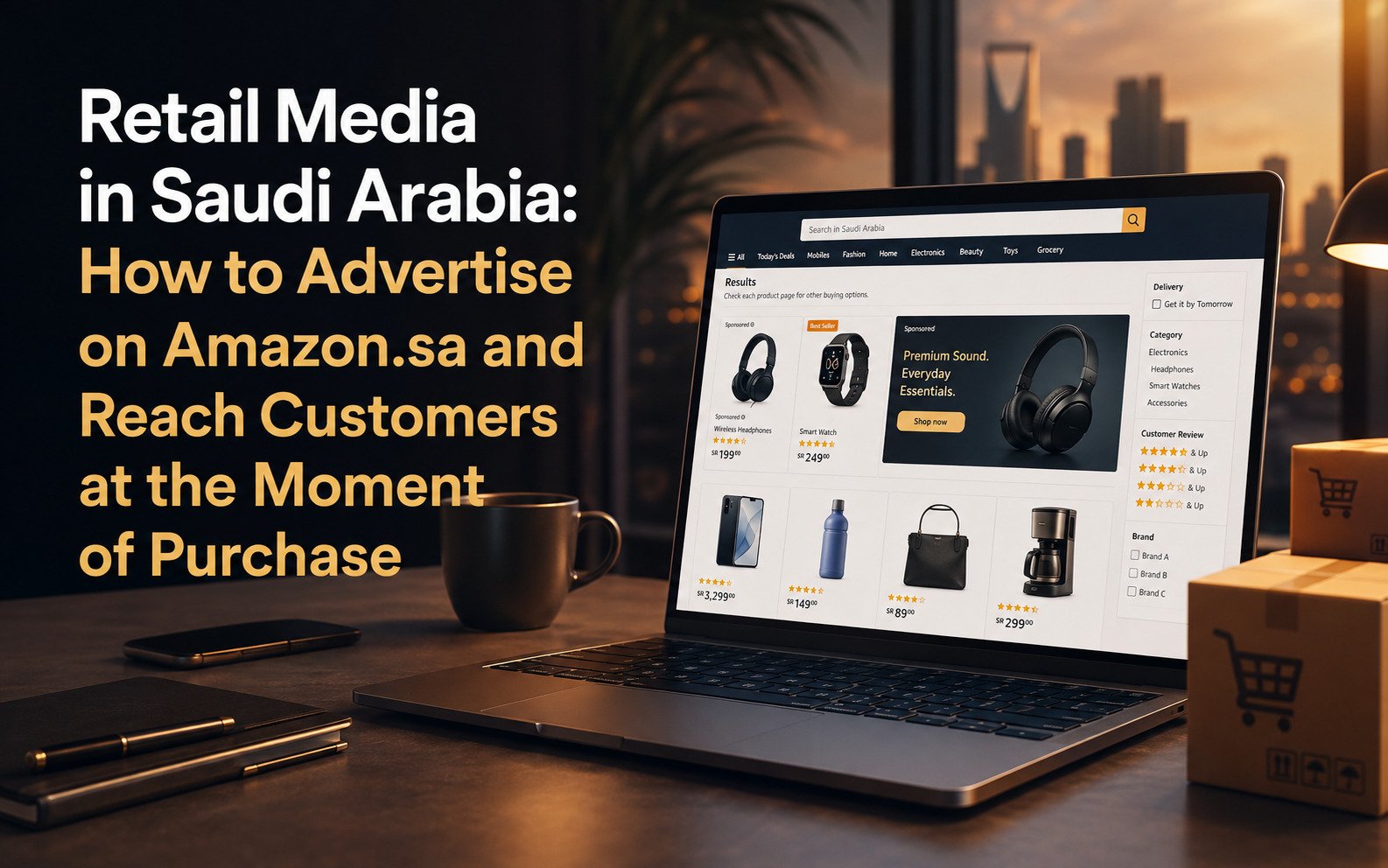
Retail media refers to advertising displayed within digital retail platforms and online marketplaces, using shopping context and customer interests to reach potential buyers. On Amazon.sa, brands and sellers can use Sponsored Products, Sponsored Brands, Brand Stores, display advertising, and other available formats to reach people who are actively searching for products or comparing alternatives.
These ads succeed when the product page is strong, the targeting is relevant, and the price and inventory are competitive. The goal is not simply to buy additional visibility, but to reach customers at a moment when they are close to making a purchase decision.
What Is Retail Media?
Retail media consists of advertising placements offered by retail platforms to brands and sellers within the shopping journey or across the platform’s wider advertising network.
It differs from social media advertising because users on retail platforms may already be researching, comparing, or preparing to purchase, not simply browsing entertainment content. Shopping data and search behavior allow companies to present a relevant product within a high-intent context, then measure whether the advertisement generated a click, order, or sale.
Why Does Retail Media Matter to Businesses in Saudi Arabia?
Retail media allows businesses to connect marketing activity directly with sales, particularly for brands that sell through Amazon.sa. It can support new products that need visibility within search results and established brands competing in crowded categories such as beauty, electronics, home products, food, and fashion.
It can also be used during major Saudi seasons, including Ramadan, Eid, back-to-school campaigns, Saudi National Day, and promotional periods. However, strong purchase intent does not guarantee success. The product offer, page quality, reviews, and price remain essential factors.
What Types of Advertising Are Available on Amazon.sa?
Sponsored Products promote individual product listings and commonly appear in shopping results and on product pages. They typically operate on a pay-per-click model.
Sponsored Brands help highlight the brand and a collection of products and may direct shoppers to a Brand Store or individual product pages.
Brand Stores provide a multi-page destination where a company can present its brand story and organize products without forcing customers to navigate through disconnected listings.
Display and video solutions may also help reach audiences at different stages of the customer journey, depending on account eligibility and the availability of each advertising product in the Saudi market.
Prepare the Product Page Before Buying Advertising
Advertising cannot fix a weak product page. Before launching a campaign, make sure the product title is clear and includes the terms customers use when searching.
Use high-quality images that explain the product’s size, use, and key details. Write concise bullet points that communicate the main benefits and add a description that answers common questions and objections.
Review the price, inventory, shipping options, reviews, and return policy. When customers click an ad and find incomplete information or unconvincing images, the company pays for the visit without earning a sale.
Choose Products That Are Ready for Advertising
Do not promote the entire catalog at once. Start with products that have stable inventory, a profit margin capable of supporting advertising costs, a strong product page, and a competitive price.
A successful product can be promoted to increase sales, while a new product may be advertised to collect performance data. However, these two objectives should usually be separated into different campaigns.
Products with poor reviews or frequent stock shortages may consume the budget without generating a meaningful return. Returns, discounts, and operational costs should also be considered when determining the acceptable cost of acquiring a sale.
Automatic or Manual Targeting?
Automatic targeting allows Amazon to match the product with relevant search terms and related products based on the information contained in the product listing. It can be useful for discovering search phrases the advertiser may not have considered.
Manual targeting gives the advertiser greater control over keywords, product targets, and match types.
A practical approach is to use both methods in separate campaigns: an automatic campaign for discovery and a manual campaign for keywords and product targets that have already demonstrated strong performance. Separating them makes budget allocation and campaign decisions clearer.
How Do You Choose the Right Keywords?
Begin with keywords that describe the product, its use, and the problem it solves. Do not focus only on the most popular general terms.
A longer search phrase may generate fewer clicks, but the user may be closer to making a purchase. Use search-term reports to identify what customers typed before clicking or buying, then transfer successful terms into manual campaigns.
When available, use negative targeting to exclude irrelevant phrases and avoid paying for visits that do not match the product, price, or intended customer.
Target Competitor Products and Related Categories Carefully
Product targeting may allow an advertisement to appear on specific product pages or within selected categories. This can be useful when customers are comparing similar alternatives or when the brand wants to recommend a complementary product.
However, do not select competitors based on popularity alone. Compare the price, reviews, specifications, and value proposition.
If your product is more expensive and the page does not clearly explain the additional value, you may pay to introduce the customer to an option before they return to a competitor. Effective product targeting requires a page that clearly communicates why your product deserves to be chosen.
Use a Brand Store to Tell a Complete Story
A Brand Store gives companies a space to organize products by category, use, or customer need instead of leaving shoppers to move randomly between listings.
Pages can be created for seasons, new products, bestsellers, or complete solutions. Use images and videos to explain the product experience and connect advertisements to the page most relevant to their message.
If an advertisement promotes a complete skincare routine, for example, sending the user only to a single product page may be less effective than directing them to a Brand Store page that presents the full routine and encourages the purchase of multiple products.
Which Performance Metrics Should You Monitor?
Monitor impressions, clicks, and click-through rate, but always connect them to sales. Important indicators include cost per click, conversion rate, return on advertising spend, and advertising cost compared with attributed sales.
Also examine search terms that spend without generating purchases, products that gain organic sales after their visibility improves, and new-to-brand customer metrics when available.
Do not make reducing advertising costs an isolated objective. A higher-cost campaign may be appropriate when launching a new product, while a mature product may require stricter profitability targets.
Practical Example: A Campaign on Amazon.sa
Imagine a Saudi skincare brand promoting a moisturizing collection during Ramadan. The company begins by improving the product listings and grouping the products within a seasonal Brand Store page.
It then launches an automatic Sponsored Products campaign to discover search terms, a manual campaign targeting phrases related to dryness and hydration, and a Sponsored Brands campaign directing customers to complete product collection.
After two weeks, the company pauses search terms that spend without producing sales and increases the budget for the keywords and product targets with the highest conversion rates. In this way, the company learns from shopper behavior and develops the campaign instead of distributing the budget equally across all targets.
Mistakes That Waste Amazon Ads Budgets
Common mistakes include advertising an out-of-stock product, launching campaigns before improving the product listing, grouping unrelated products into one campaign, and failing to review search-term reports.
Budget can also be wasted when the company’s own campaigns compete against each other for the same keywords without proper organization or when bids are increased without understanding the product’s profit margin.
Another mistake is depending on advertising while ignoring reviews, pricing, and after-sales service. Retail media is closely connected to commerce. The advertisement creates the opportunity, but the product and customer experience convert it into a sale and repeat purchase.
Read Also: WhatsApp Marketing in Saudi Arabia: How to Turn Conversations and AI Agents into Sales
Conclusion: Advertise Where Interest Becomes a Purchase Decision
Retail media gives companies in Saudi Arabia the opportunity to reach customers within the shopping environment itself. However, success requires more than opening a campaign.
Choose the right product, improve the listing, separate discovery campaigns from manual campaigns, and use performance data to refine keywords, bids, and budget allocation.
When advertising works together with the Brand Store, pricing, inventory, and product content, Amazon.sa can become a channel that combines product discovery, brand building, and measurable sales.
Do You Want to Turn Your Amazon Ads Budget into Measurable Growth?
Visibility within shopping results matters, but real value begins when the campaign knows which product to support, which customer to target, and which keyword deserves investment.
The Wolf Head team can help you build an integrated retail media strategy for the Saudi market—from product-page optimization and Brand Store design to campaign management and sales analysis.
Let Wolf Head place your brand in front of customers now when they are not simply looking for content but preparing to make a purchase.