
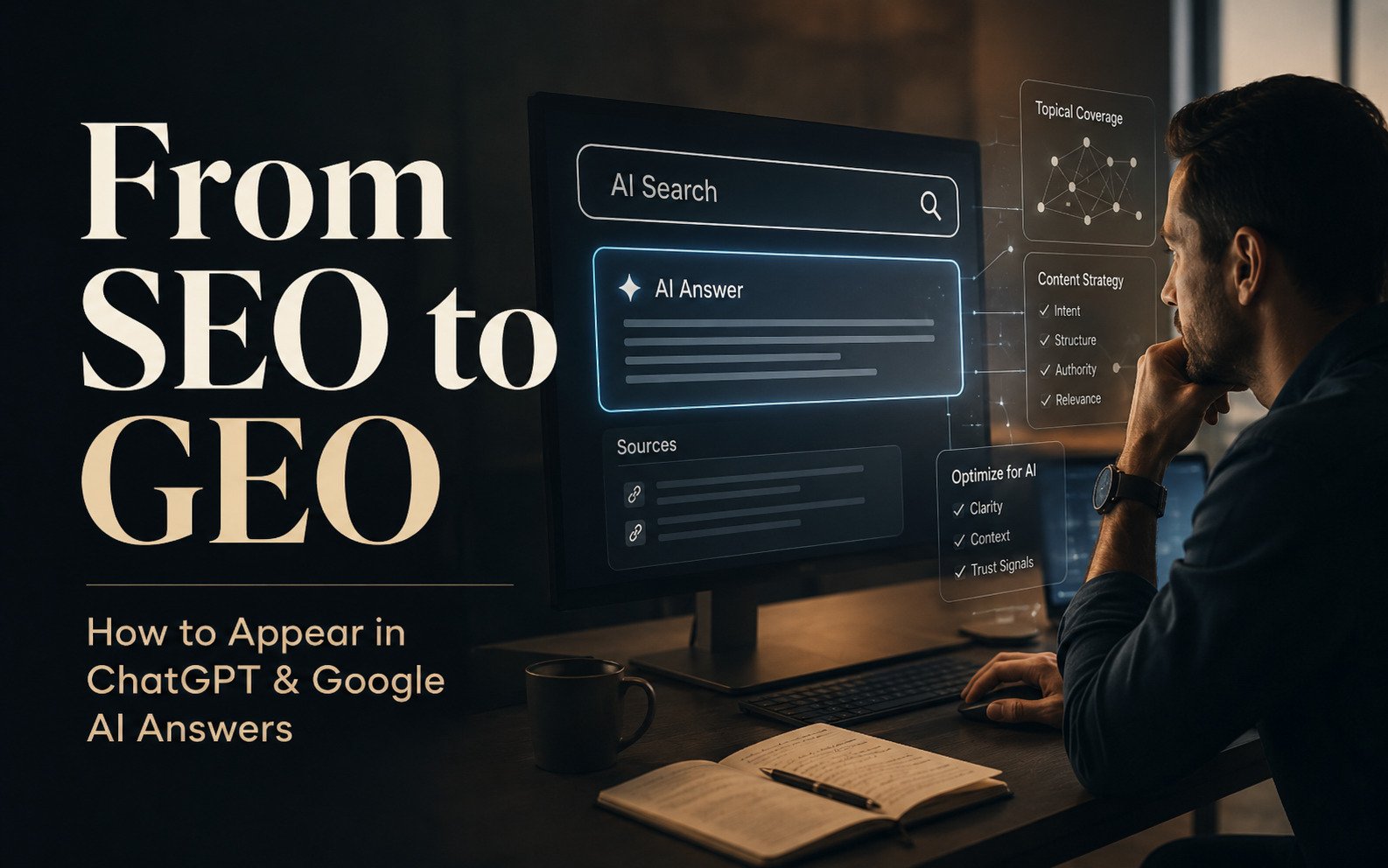
To increase the chances of your company’s content appearing in ChatGPT and Google AI answers, the content must first be accessible for crawling and indexing, then provide a clear, trustworthy answer that offers more value than generic or repetitive material. Generative Engine Optimization does not replace traditional SEO. Instead, it builds upon it by placing greater emphasis on user intent, demonstrated expertise, well-organized information, and original examples or data. In the Saudi market, companies can improve their visibility by answering genuine customer questions, highlighting their local expertise, and becoming a reliable source that both users and AI systems can easily understand and reference.
What Is the Difference Between SEO and GEO?
SEO refers to optimizing websites and content for visibility in traditional search engine results. GEO, or Generative Engine Optimization, describes the process of preparing content to appear within answers generated by AI-powered search and answer engines.
This does not mean that companies need two separate strategies. Content built on a strong technical foundation, written to satisfy user needs, and supported by original and trustworthy information has a better chance of performing in both environments. The main difference is that AI-powered search may extract information directly from a page and include it within a broader, generated answer rather than presenting the page only as a link.
How Do AI Search Engines Select Their Sources?
AI answer engines look for sources that help them produce responses that are clear, accurate, and genuinely useful. Keyword density and article length alone are not enough. The page should be easy to understand, relevant to a defined topic, updated when necessary, and capable of supporting its claims with evidence, examples, or practical expertise.
The brand’s digital reputation, the clarity of the company or author’s identity, and the consistency of its information across different platforms may also strengthen the source. The more specific and useful the content is, the easier it becomes to extract and reference compared with pages that repeat broad definitions already found across hundreds of websites.
Begin the Article with a Direct, Quotable Answer
One of the most effective ways to prepare content for AI-powered search is to provide a direct answer near the beginning of the article before moving into detailed explanation.
For example, if the question is, “How do you choose a marketing agency?” the opening paragraph should immediately explain the most important selection criteria, followed by separate sections that expand on each criterion. This approach helps readers who need a quick answer and gives search systems a clear passage that can be easily understood.
Avoid lengthy introductions that delay the main answer. Clarity does not mean oversimplification; it means presenting the most important information first and then adding depth.
Provide Original Expertise That Other Websites Cannot Copy
Generic information is now available in enormous quantities. To stand out, companies need to add something that cannot be produced by simply rewriting existing search results.
This may include experience from a real project, a comparison table, a specialist’s opinion, recurring mistakes observed by the team, a Saudi-market scenario, or a practical decision-making framework. Instead of merely explaining why content is important, describe how a company changed a client’s content strategy and what happened afterward.
Original expertise gives the article genuine value and helps the brand establish authority within its field.
Build Articles Around Real Customer Questions
Instead of publishing overly broad topics such as “A Complete Guide to Marketing,” identify the questions customers ask before purchasing, while comparing providers, and after beginning a working relationship.
These questions may include: How much budget does a campaign need? When should results appear? What is the difference between an agency and a freelancer? How should return on investment be measured?
You can then create a main article covering the wider topic and connect it to supporting articles that answer more specific questions. This structure helps search systems understand the relationship between topics and allows the website to become a connected knowledge resource rather than a collection of isolated articles.
Make Your Website Easy to Crawl and Index
Even excellent content cannot appear in search results if search engines cannot access it. Companies should ensure that important pages are not blocked, broken links are repaired, URLs are clear, internal links follow a logical structure, and the sitemap is submitted correctly.
Pages should also load quickly, display well on mobile devices, and present their main content in a format that search crawlers can access. Improving visibility in AI-powered search begins with a technically sound website, not with a separate editorial trick.
Strengthen the Identity of the Brand and the Author
Both readers and search systems need to understand who is behind the content. Create a clear company page that explains the organization’s field, experience, services, and contact methods.
For specialist articles, include an author or expert profile and explain why that person is qualified to discuss the subject. It is also important to keep the company’s name, services, and core information consistent across its website, social media accounts, and external platforms.
These signals do not guarantee visibility on their own, but they make the source more transparent, credible, and consistent.
Use Structured Data Without Depending on It Alone
Structured data can help search engines understand certain parts of a webpage, such as articles, products, frequently asked questions, and local business information.
However, structured data is not a guaranteed shortcut to appearing in AI-generated answers, and it cannot compensate for weak content. Use the appropriate markup only when it accurately reflects what is visible on the page. Avoid adding reviews, questions, or other information that users cannot actually see.
The goal is to organize information more clearly, not to manipulate the system. Valuable content and a technically reliable website remain more important than adding unnecessary markup.
Avoid GEO Tricks and Large-Scale Automated Content
Companies do not need to divide every paragraph into extremely short statements, publish a page for every possible variation of a question, or automatically generate hundreds of articles in an attempt to influence AI search engines.
These practices may create weak and repetitive content and damage the brand’s reputation rather than improve its visibility. AI tools can support research, organization, and drafting, but human review, original expertise, and factual verification must remain part of the process.
The goal is not to publish the greatest quantity of content. It is to produce the best possible answer for a clearly defined audience.
How Can You Measure Visibility in AI-Powered Search?
Do not measure performance only through the ranking of a single keyword. Monitor organic traffic growth, new search queries, the pages attracting users, and referral traffic from AI answer engines when it appears in analytics tools.
Also track branded searches, the number of customers who say they discovered the company through an AI-generated answer, and the quality of conversions produced by the content. Not every platform provides complete reporting, so businesses need to combine several indicators and connect them to actual inquiries, leads, and sales.
A Practical GEO Content Plan for Your Company
Begin by listing your customers’ most important questions and selecting one primary question for each article. Provide a direct answer in the introduction, divide the article into clear supporting questions, and include original expertise or a practical example from the Saudi market.
Review the technical quality of the page, link the article to relevant internal resources, and update it whenever important information changes. After publication, monitor search queries, engagement, and conversions, then improve the article according to what users are actually looking for.
In this way, GEO becomes a practical extension of a strong content strategy rather than merely a popular new term.
Conclusion: Visibility in AI Answers Begins with Real Value
Moving from SEO to GEO does not mean abandoning search engine fundamentals. It means developing them for a more conversational and intelligent search experience.
Companies in Saudi Arabia need content that is clear, accessible, experience-based, and capable of answering the questions that influence customer decisions. No formula can guarantee that an AI system will select a particular article, but every improvement in quality, credibility, and structure increases the chances of the content being discovered and used.
The brand that becomes the best source of information has a stronger opportunity to appear when customers search, whether through a traditional list of links or an AI-generated answer.
Do You Want Your Brand to Become a Source AI Search Engines Cite?
Visibility in the new search environment does not come from adding fashionable terms to old articles. It comes from building content that deserves to be read, retrieved, and referenced.
The Wolf Head team can help you develop a content strategy that combines SEO, AI-search optimization, original expertise, and the technical structure required for the Saudi market.
Do not settle for appearing in front of an algorithm. Let Wolf Head help you build a trusted knowledge source where both customers and search engines can find the answers they need.